Table of contents
Vertical luxury in Dubai has, over the past fifteen years, settled into a recognisable hierarchy. At its apex sit a handful of ultra-prime towers whose pricing, finish quality and view orientation set the reference points against which every subsequent project is read. Within that hierarchy, the term “Downtown reference” carries a specific meaning. It denotes a tower considered representative of the district’s prevailing standard of luxury at a particular moment in its evolution. The arrival of a new Emaar flagship inside the original Downtown grid invites an immediate question. Where, in that hierarchy, does the latest project belong?
A Vocabulary That Has Evolved Quietly
The vertical luxury market in Downtown Dubai has not stood still. The earliest generation of Downtown residences, completed in the late 2000s and early 2010s, established a baseline anchored in spacious layouts, restrained finishes and the novelty of living within a newly created urban centre. A second generation, including the Address-branded residences and projects such as Burj Vista, introduced a hospitality-led approach to luxury, with branded service propositions layered into the residential offering. A third generation, exemplified by IL Primo and the most recent Burj Crown and Forte releases, has refined the architectural and material vocabulary while raising the bar on view-corridor design and amenity programming.
Within this evolution, the entry of The Heights by Emaar is best understood as part of the next refinement. The tower sits in a register somewhere between the ultra-prime statement of IL Primo and the more accessible, broadly distributed elegance of the Address-branded residences. The mix of studios through four-bedroom apartments and penthouses indicates a project pitched to address multiple segments simultaneously rather than to concentrate on a single ultra-prime band.
Knight Frank’s Dubai Prime Residential reporting has consistently observed that the most resilient towers in the district have tended to be those that combine a clear architectural identity with a sufficiently broad unit mix to attract diversified demand. The Heights, on the basis of available product information, appears designed precisely along that axis.
Pricing Tiers and How They Read Against the District
Pricing remains officially undisclosed at the time of writing, but commentary circulating through broker channels suggests the project is positioned within the upper band of Downtown’s prevailing pricing, with penthouses sitting in a category of their own. The broker community generally distinguishes among several tiers when discussing Downtown product. Entry-level Downtown supply, typically associated with non-Burj-facing inventory in older towers, sits at the lower end. Mid-tier Downtown inventory, often found in mature Emaar releases, sits in the middle. Upper-tier Downtown inventory, anchored by direct Burj-view towers and the most recent flagship releases, occupies the top.
The Heights appears to enter the market within the upper tier. The proximity to the Burj Khalifa, the design treatment, the developer’s brand and the orientation of principal apartments all reinforce that positioning. Bayut’s quarterly data on price-per-square-foot in Downtown has, over recent cycles, shown the gap between upper-tier and mid-tier inventory widening. JLL’s MENA real estate updates have similarly noted that the premium attached to direct-view trophy stock has continued to compound.
For a buyer comparing the new release with existing Downtown options, the relative value proposition is therefore not solely about absolute pricing. It is about the long-term durability of the address.
Penthouses and the Top of the Stack
Information available through broker channels and reflected on the official The Heights brochure suggests the penthouses occupy the upper section of the tower. In Downtown, penthouse pricing has historically operated on a different curve to the rest of the inventory. The pool of buyers is smaller. The marketing is quieter. The transactions, when they occur, often establish reference points that are quoted in market reports for years.
Forbes Middle East has previously highlighted that Dubai’s penthouse market, particularly inside flagship districts, has begun to attract a more internationally diverse set of buyers, with European, South Asian and broader GCC families increasingly competing for the highest-tier inventory. The Heights penthouses are likely to be marketed through selective, by-introduction channels rather than through the general broker community, in line with the developer’s customary approach to its top-tier product.
Comparable Towers and the Logic of the Reference
To define what a Downtown reference means today, it helps to look at the towers most commonly cited in the district’s contemporary luxury vocabulary.
IL Primo, with its association to the Dubai Opera and its larger-format apartments, established a new ceiling for ultra-prime Downtown pricing on its release. The Address Residences Dubai Opera and Address Sky View extended the developer’s branded-hospitality residential proposition with a distinct architectural identity and a sky-bridge experience. Burj Crown introduced a more contemporary sculptural profile to the district. Forte, with its twin-tower arrangement, offered an alternative reading of vertical density adjacent to the Opera District. Burj Royale gave the market a compact, view-oriented entry point inside the masterplan. Grande, set against the Opera, presented a more refined, less corporate vertical proposition.
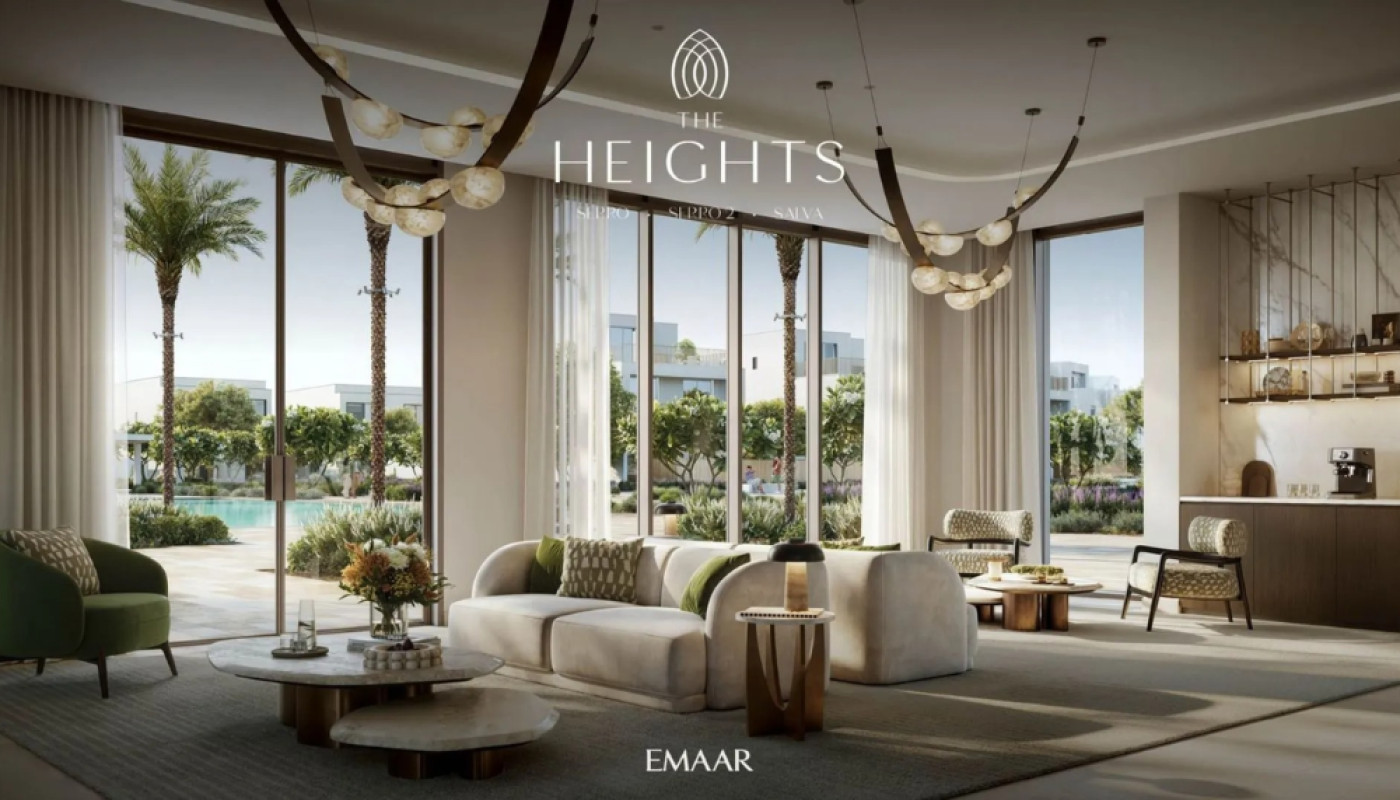
The Heights enters this lineage without claiming to displace any of these references. It instead occupies a position that brokers describe as the next disciplined extension of the developer’s Downtown product franchise. The architectural treatment is contextual rather than disruptive. The unit mix is broad rather than narrowly ultra-prime. The amenities, in line with what has been disclosed through marketing materials, follow the Emaar Downtown playbook of pool deck, wellness facilities, residents’ lounge, dedicated children’s facilities and concierge services.
It is the consistency, not the disruption, that makes the project a candidate to become a new reference.
What “Vertical Luxury” Now Means Downtown
The phrase “vertical luxury” has evolved meaningfully over the past decade. In the early generation of Downtown towers, it referred primarily to height, view and the novelty of city-centre living. By the middle generation, it incorporated hospitality service, branded design and curated amenity programming. By the most recent generation, it has come to include considerations that were absent from earlier conversations: indoor air quality, low-glare glazing, view-corridor architecture, biophilic detailing in the amenity spaces, and the resale liquidity of an internationally recognised address.
Robb Report Real Estate and Forbes Middle East have, over the past several years, repeatedly highlighted how the criteria by which prime towers are judged have become more granular. View quality is no longer a single attribute. It is now segmented into primary, secondary and tertiary orientations, with each commanding a different premium. Service is no longer a single attribute either. It is segmented into concierge, valet, wellness, F&B and resident-lifecycle services, each of which carries its own benchmark.
Emaar’s latest flagship at Downtown has been positioned, on the evidence of marketing materials and broker briefings, to perform across most of these axes. The tower is oriented to maximise primary Burj-view apartments. The amenity programme, as far as it has been disclosed, follows the segmented architecture that recent Downtown launches have favoured. The finish vocabulary leans on neutral palettes, floor-to-ceiling glazing and stone insets, consistent with the developer’s contemporary register.
The Service Layer
What is sometimes overlooked in the analysis of vertical luxury is the resident-lifecycle service layer. Reception standards, maintenance turnaround times, valet performance, package handling, gymnasium operational hours and concierge responsiveness are not glamorous attributes, but they shape the lived experience of a tower in ways that ultimately influence resale narrative. Emaar’s Downtown towers have, over the years, built a reputation for predictable operational quality, and brokers expect the new release to maintain that standard.
The Buyer’s Calculation
For a buyer comparing the new project with the most directly comparable existing Downtown stock, the calculation tends to come back to several variables.
The first is view orientation. Direct Burj views are widely understood to command a premium that holds through cycles. The Heights appears engineered to maximise this category of inventory.
The second is service proposition. The developer’s track record of consistent operational standards across its Downtown portfolio reduces the perceived risk associated with buying off-plan.
The third is resale liquidity. Knight Frank has noted that branded and master-developer Downtown towers tend to display narrower price corrections during cyclical slowdowns than equivalent non-branded product. This dimension is particularly important for international buyers, for whom exit liquidity is often as significant as entry pricing.
The fourth is the fiscal frame. The UAE’s lack of personal income tax, absence of capital gains tax on real estate, freehold availability for foreign nationals and Golden Visa eligibility for property purchases above AED 2 million all support the value proposition for international buyers.
Taken together, these variables explain why the new release is being read by brokers and analysts as a project with strong potential to become a reference for the next phase of Downtown’s evolution.
Why the District Continues to Set the Reference
There is a reason why Downtown Dubai, more than any other district in the emirate, continues to set the reference for vertical luxury. The combination of the Burj Khalifa, the Dubai Mall, the Dubai Fountain and the Opera District produces a concentration of urban experience that is difficult to replicate. New districts can offer beachfront, marina, creek frontage or quieter inland environments, but none of them can replicate the Downtown ecosystem in its entirety.
Knight Frank’s Dubai Prime Residential commentary has frequently underlined that the district remains the primary anchor in the city’s prime hierarchy, with continued international demand reinforcing its status. JLL’s MENA real estate updates have echoed this, noting that the district’s hotels, retail and entertainment ecosystem provide a permanent demand environment that supports both residential and commercial values.
In that context, the addition of a new Emaar flagship inside the original Downtown grid is more than a product launch. It is a contribution to the district’s continuing definition of what vertical luxury in Dubai looks like.
The Reference Is Always Provisional
It is worth noting that the role of “Downtown reference” is always provisional. The towers that defined the term ten years ago have been joined, and in some respects superseded, by towers that defined it five years ago. The towers that define it today will, in time, be joined and refined by subsequent releases. This is the nature of a maturing prime district.
What makes the latest Emaar release a particularly credible candidate for becoming the next reference is its disciplined alignment with the district’s prevailing architectural, service and amenity vocabulary, combined with its location inside the most constrained and most recognisable section of the masterplan. The Heights does not aim to redefine Downtown luxury. It aims to articulate its current state with clarity. In a market where many projects compete for novelty, that kind of precision tends to age well.
The judgement of whether the project ultimately settles into the role of new Downtown reference will be made by the secondary market, by analysts and by the slow, accumulated conversation of brokers, residents and buyers over the coming years. For the moment, the signs suggest that it has every credible attribute to do so.
On the same subject

Understanding The Legal Landscape Of Real Estate Transactions?

How Fixed Fee Conveyancing Simplifies Property Transactions

Invest in Sint Maarten: why it's the perfect place for real estate opportunities

Exploring The Allure Of Luxury Mountain Retreats For Year-round Vacations

Exploring Luxury Real Estate Trends And Lifestyles In Coastal Cities
